Based on information from the National Pesticide Information Center (NPIC*) the U.S. Environmental Protection Agency (EPA), and Toxicology Excellence for Risk Assessment*
https://www.npic.orst.edu/factsheets/archive/glyphotech.html
https://www3.epa.gov/pesticides/chem_search/reg_actions/reregistration/fs_PC-417300_1-Sep-93.pdf
https://www.tera.org/Alliance%20for%20Risk/ARA_Dose-Response.htm.
Christopher R. Kirman, Pierluigi Cocco, Guy D. Eslick, Paul J. Villeneuve & Sean M. Hays, Meta-Analyses of Glyphosate and Non-Hodgkin Lymphoma: Expert Panel Conclusions and Recommendations, 8 Internat’l J. Toxicol, Risk Assessment 1(2022), available at https://www.clinmedjournals.org/articles/ijtra/international-journal-of-toxicology-and-risk-assessment-ijtra-8-044.php.
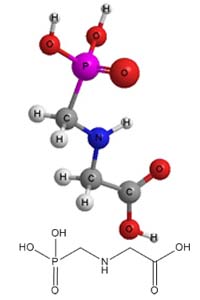
Molecular Structure of Glyphosate
Highlights
(Please refer to the above documents to get detailed information on the highlights).
Glyphosate is a non-selective systemic* herbicide that is applied directly to plant foliage. It is a glycine derivative. It’s ability to be an herbicide was first reported in 1971 and registered by the EOA in 1974 and reregistered in 1993.
Systemic herbicides destroy all plants in their vicinity. Unlike contact killers, they move through the entire plant, making them highly effective for clearing all vegetation in specific areas.
Glyphosate is one of the most widely used herbicides in agriculture, forestry, industrial weed control and lawn, garden and aquatic environments.
Plants exposed to glyphosate show stunted growth, loss of green color, wrinkling/malformation of leaves and tissue death. The plant will die in 4-29 days.
The pathway on which glyphosate works (shikimic) is found only in plants and some microorganisms – not in mammals. This leads to glyphosate having low toxicity* in humans and animals.
Some plants have been genetically modified to be resistant to glyphosate these include soybeans, corn, cotton, and canola.
Studies have shown low toxicity* when fed to rats, mice, goats.
Studies also have found that glyphosate is low in toxicity* to rabbits when applied to skin. In other studies, investigators saw mild eye irritation in rabbits that cleared up in seven days.
In a human study, Roundup (41% glyphosate) was applied to the skin of 204 male and female volunteers. No sensitization was observed.
Glyphosate is very low in toxicity* to rats when inhaled.
Animals exposed to glyphosate herbicides have displayed anorexia, hypersalivation, lethargy, vomiting, and diarrhea for 2-24 hours after exposure. The surfactants (compounds that reduce the surface tension between two liquids, a gas and a liquid, or a liquid and a solid) in formulated products (such as Roundup) are thought to be responsible for these symptoms that show up within 30 minutes to 2 hours after ingestion.
*Low toxicity refers to a substance that causes minimal, negligible, or no significant harm to humans or the environment at typical exposure levels. It indicates a high threshold for damage, requiring large doses to induce poisoning, and is often synonymous with “low hazard,” “gentle,” “mild,” or “safe” in products. Low-toxicity materials and substances are commonly found in everyday products and specific, safer applications:
- Household Items: Hand dishwashing detergents, silica gel packets, and children’s water-based paints.
- Personal Care: Lip balm, cosmetics, and lotions.
- Safety Alternatives: Using castile soap or vinegar-based sprays instead of heavy-duty cleaners.
- Industrial/Medical: Specific medicinal nanoparticles (e.g., iron oxides) and green detergents that break down quickly.
Glyphosate: A Simple Overview
Glyphosate is a widely used herbicide designed to kill unwanted plants. It has been in use since the 1970s and is commonly applied in farming, forestry, lawn care, gardening, and public areas such as roadsides.
How Glyphosate Works
Glyphosate is a systemic herbicide, meaning it is absorbed through a plant’s leaves and moves throughout the plant. It interferes with a process plants need to grow and survive. After treatment, plants may stop growing, lose their green color, become misshapen, and eventually die—usually within a few weeks.
This process affects plants and some microorganisms but does not occur in humans or animals, which is why glyphosate generally has low toxicity in people.
Use in Agriculture
Some crops, including corn, soybeans, cotton, and canola, have been genetically modified to tolerate glyphosate. This allows farmers to control weeds without harming these crops.
Effects on People and Animals
Research shows glyphosate has low toxicity in mammals. Studies involving animals and human volunteers report minimal effects from skin contact, inhalation, or accidental exposure. Mild eye irritation has been observed in some animal studies but it resolved within a short time. The Veterinary Poisons Information Service in London, England, looked at 150 cases of dogs exposed to glyphosate over an 8-year period and found 40% had no clinical symptoms 45% had mild to moderate clinical symptoms, with 15% classified as serious.
In a review of 80 cases of intentional ingestion by humans (suicide attempts) typical symptoms included erosion of the gastrointestinal tract, dysphagia or difficulty swallowing, or gastrointestinal hemorrhage.
Based on many tests, glyphosate is not expected to have immunotoxicity or neurotoxicity.
The chronic reference dose for glyphosate is 1.75 mg/kg per day. This is an estimate of daily oral exposure to a substance that is likely to be without appreciable risk of harmful health effects over a lifetime.
When adverse symptoms such as vomiting or diarrhea occurred in studies of animals, they were mostly linked to other ingredients added to commercial herbicide products, rather than glyphosate itself.
Eye and skin irritation have sometimes been reported, but permanent ocular, or dermal damage is very rare.
Cancer
EPA has found that glyphosate is not likely to be carcinogenic to humans. To reach this conclusion, EPA reviewed available epidemiological (presence of disease in human populations) animal studies, and genotoxicity data (agents or substances that damage genetic material (DNA or chromosomes) in cells, potentially causing cancer). The results of many genotoxicity tests have been overwhelmingly negative. Animal studies that showed positive results were too high to be considered relevant for human risk assessment.
Regulatory authorities in Canada, Japan, Austria, and the European Union have conducted independent cancer risk assessments and agree with the U.S. EPA findings of not likely to be carcinogenic.
Learn More
The National Pesticide Information Center (NPIC)* and the U.S. Environmental Protection Agency (EPA) provide science‑based information about glyphosate and other pesticides to help people make informed decisions about their use.
To find a list of products containing glyphosate registered in your state see http://npic.orst.edu/reg/state_agencies.html.
*NPIC provides objective, science-based information about pesticides and pesticide-related topics to enable people to make informed decisions about pesticides and their use. NPIC is a cooperative agreement between Oregon State University and the U.S. Environmental Protection Agency.
*TERA is a non-profit, tax-exempt scientific organization established in 1995 to support public health protection through toxicological research and risk assessment. TERA provides independent, transparent, and peer-reviewed risk analyses for government, industry, and NGO sponsors, focusing on chemical assessment, pharmaceutical toxicology, and risk education.